Hi, I'm Madhav
I like breaking down complex problems into simpler manageable parts.
I'm based in

Bengaluru, India and I'm looking for exciting opportunities at design-led companies building consumer-facing products.
%20(Custom).jpg)
%20(Custom)%20(Custom).jpg)
%20(Custom).jpg)
%20(Custom).jpg)
This is a board game that I designed for visually impaired persons as part of the project 'Play For All' initiated by Ludic Design for Accessibility at Microsoft Research. It is an adventure-style board game designed for the ages 8-14, where you place hex tiles to build your own path towards the treasure in the centre. It is augmented by cards with raised symbols and a console for each player to park their cards and to read exchange rates at which you could obtain tiles by giving away cards. Check out the complete process booklet.
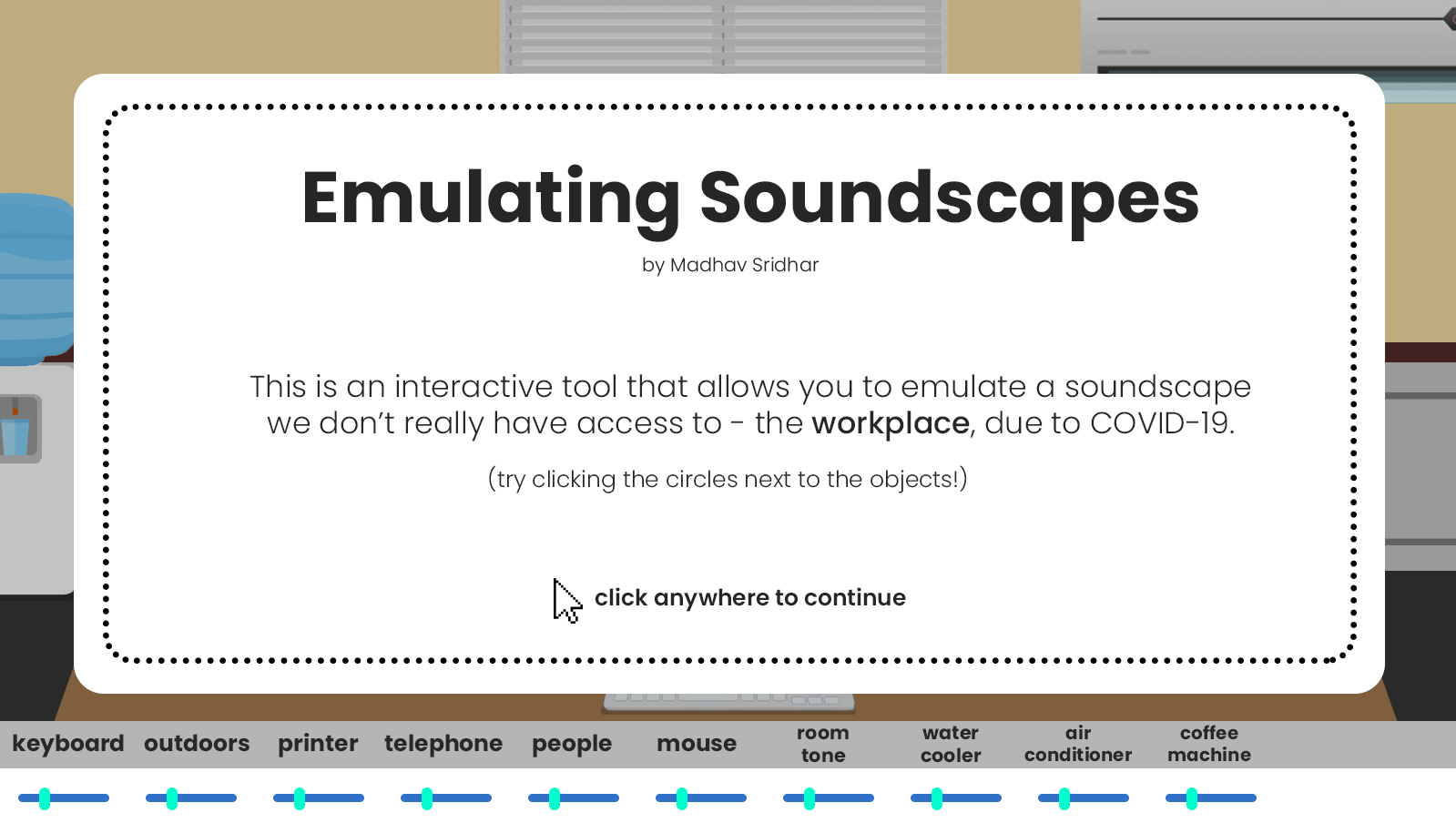
During the COVID-19 pandemic, we all had to suddenly work from home for extended periods of time. That change in work environment gave us a novel chance to understand the components of this mental barrier between work and home, and how that environment conditions us to be in a certain 'headspace'. The soundscapes we're present in often inform our subconscious mood and help us either focus or relax. This is an interactive experience built in p5.js that puts you in a typical office space with the usual sounds around, while being able to adjust the levels of those sounds.
%20(Custom).png)
%20(Custom).png)
%20(Custom).png)
.png)
These are outputs from a Python program I wrote to visualise zoomed-in parts from the Julia set by plotting the real-complex plane and assigning RGB values to each point depending on how those x and y values compute within the expression that defines the set. The colour palettes can be tweaked to an extent by tweaking the weightage of red, green and blue values from the output of the mathematical expression.




.png)
here%20thing.png)